
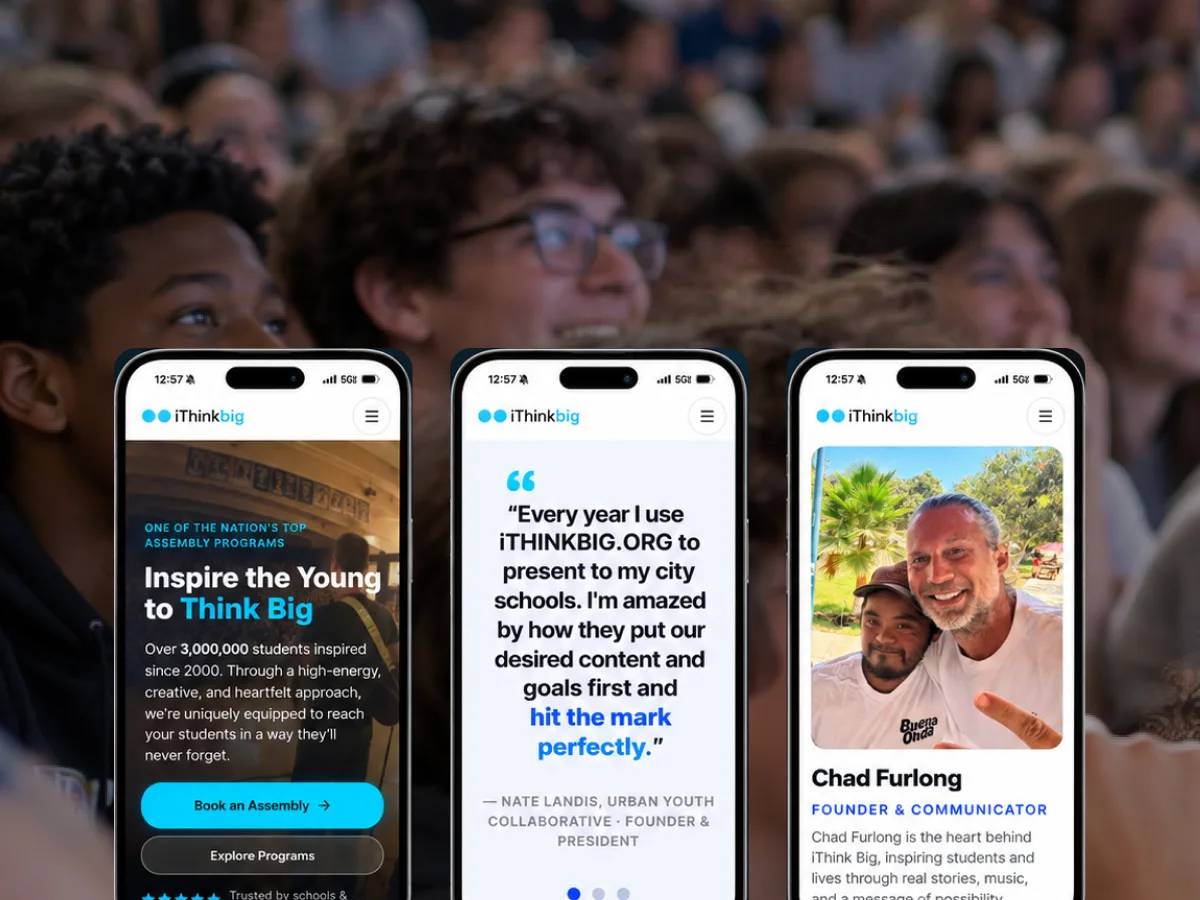
iThink Big
A live assembly program translated into a site that moves like the show and books like a business.
The front end is the last mile between well-designed software and the thing people actually touch. It's where intent gets protected or quietly lost, so we treat it as craft, not translation.
Front-end engineering has a reputation problem. In a lot of organizations it's treated as the translation layer — the place where somebody converts a design file into HTML and CSS, more clerical than creative. That framing is how good designs become mediocre products.
Everything a user experiences happens here. Not in the mockup, not in the spec, not in the database. Here. How fast it loads, whether it works on a bad connection, whether it responds when you tap it, whether it makes sense to a screen reader, whether the type sits right at 320px. Those are all front-end decisions, and every one of them is a design decision that just happens to be expressed in code.
So we don't hand designs to a separate build team and hope. The people who made the design decisions stay close to the code that implements them. That's the whole reason the details survive — the transition timing, the empty state, the sentence that had to be two words shorter to avoid an ugly wrap.
Performance gets treated as something you fix at the end, once someone complains. By then it's expensive, because the causes are structural: the framework you chose, the images nobody compressed, the fonts blocking the first render, the third-party script someone added in a hurry.
We set performance budgets early and design against them, because an interface that's beautiful and slow is just a slow interface. Users don't grade on a curve — they leave. And on the devices and networks a lot of your customers actually use, the difference between considered and careless engineering is the difference between software they'll use and software they'll abandon.
Most accessibility failures aren't malice or ignorance — they're the predictable result of doing it last. Retrofitting semantics onto markup that was built without them is miserable, expensive, and never quite complete.
Built into the code from the start, most of it is nearly free: real semantic HTML, sensible focus order, keyboard operability, labels that mean something, states that announce themselves. We test with the keyboard and with assistive technology, not just with a scanner that catches a fraction of the problems. Done this way, accessibility isn't a tax — it's just what competent front-end work looks like.
Any team can make one screen good. The hard part is the fiftieth screen, built by someone who wasn't there for the first, still feeling like it belongs to the same product.
That's what a real component system buys you: the good decisions get made once and then reused, instead of relitigated on every ticket. It's also what makes AI-assisted development safe rather than chaotic — the model composes from parts that were already thought through instead of inventing a new button every time it's asked.
Every Artifact engagement runs on one method: Understand → Design → Build → Launch → Grow. These are the stages where Front-End Engineering does the most work. See how we work.
Working prototypes are built in real components, so the interactions people test are the ones that ship.
The component system, performance budgets and accessibility are set early and held, with design and engineering in the same loop.
A documented component system lets the fiftieth screen feel as considered as the first, whoever builds it.
A live assembly program translated into a site that moves like the show and books like a business.
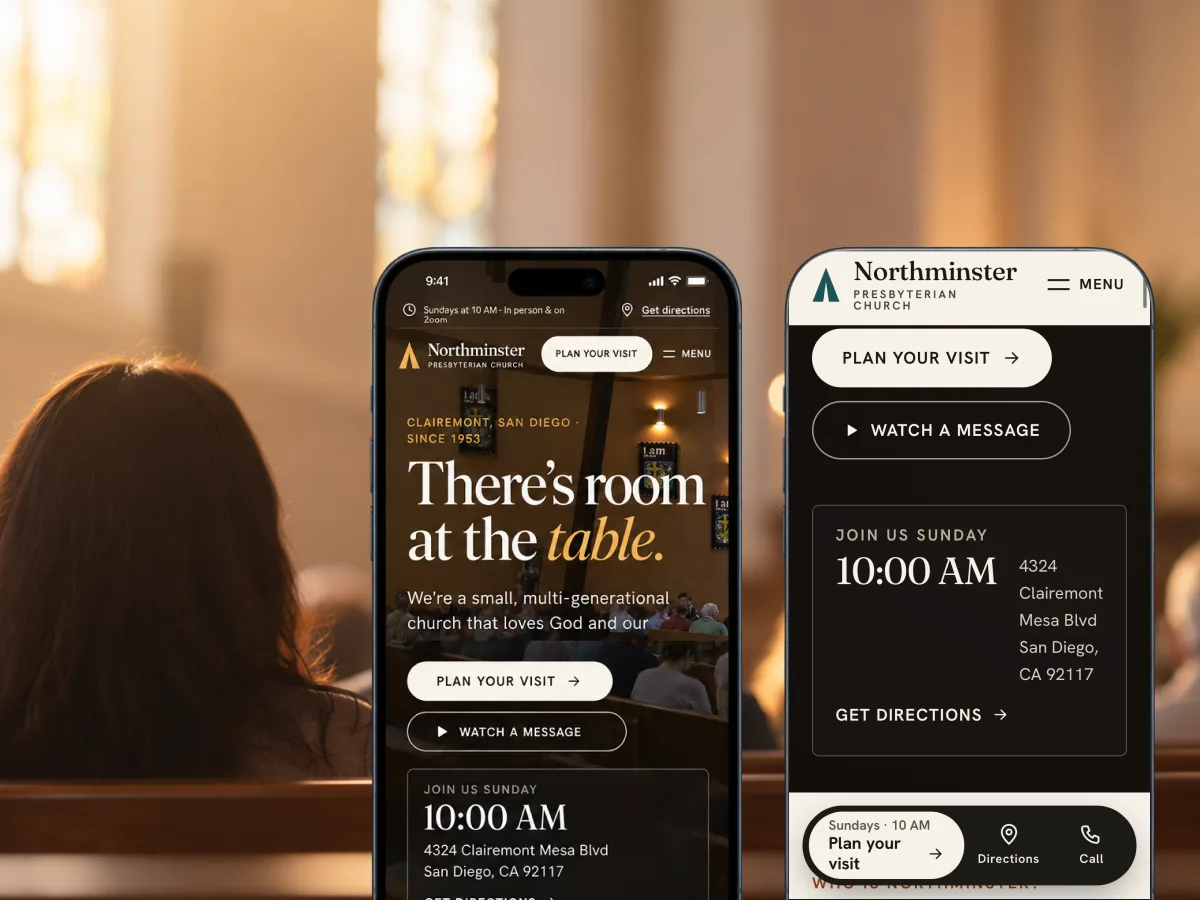
A neighborhood church in Clairemont since 1953, rebuilt around the question a newcomer actually has: what happens if I show up?
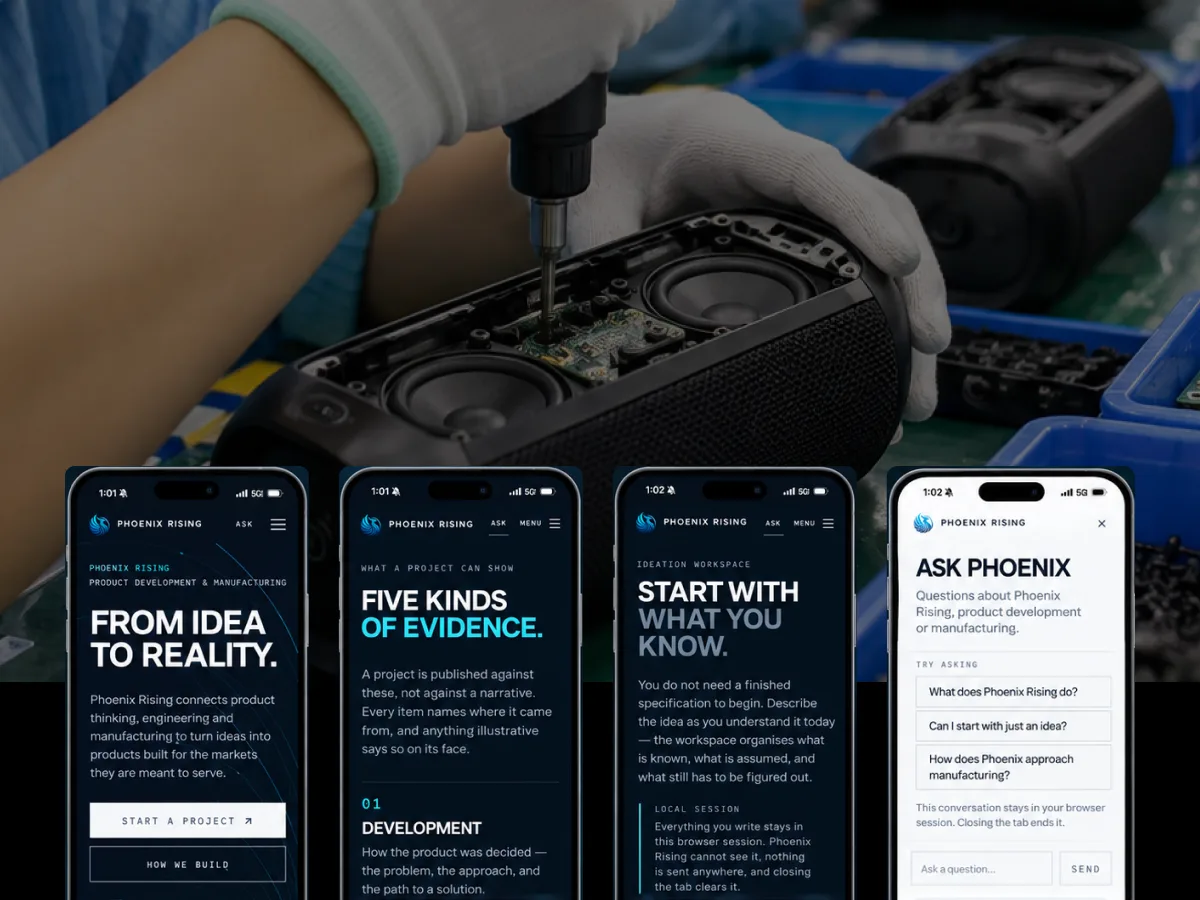
Years of manufacturing relationships across two continents, turned into a digital front door that earns trust before the first call.
Tell us the problem. We'll tell you honestly whether software is the answer — and bring the strategy, design, engineering and AI to build it.