

DropQ
An operating system for independent sellers running timed product drops — built zero to a live Stripe Connect marketplace in two weeks.
The back end is the half of your software no user will ever look at and every user will judge you by. When it's right, the experience feels solid. When it's wrong, no amount of design will save it.
Plenty of design-led teams hand the hard part to somebody else to make it actually work. We don't. Our engineers build the whole stack — the data model, the APIs, the auth, the payments, the integrations, the jobs that run at 3am when nobody's watching.
That matters more than it sounds, because the hardest problems in most software aren't on the screen. They're in the seams: what happens when two people buy the last one at the same moment, when the payment succeeds but the webhook doesn't arrive, when the timezone is wrong by an hour, when the third-party API is down and your customer still expects an answer.
You can't design your way out of any of those. They're engineering problems, and getting them right is what makes an interface trustworthy enough to be worth designing well.
Almost every expensive problem in an inherited system traces back to a data model that was decided quickly and lived for years. Get the model right and features get easier over time. Get it wrong and every new requirement is a fight with your own schema.
So we model deliberately, the same way we approach content modeling on a content platform: what are the real entities, how do they relate, what's the source of truth, what must never be duplicated. It's unglamorous, it's early, and it's the highest-leverage hour anyone will spend on your software.
Most software works fine until two people do the same thing at the same time. Then you find out whether anyone thought about it.
On DropQ we made overselling structurally impossible — not with a validation rule that checks inventory and hopes, but with an atomic conditional claim in the database, where losing the race auto-cancels and refunds. There is no interleaving where two buyers get the last item. That's the difference between a rule and a guarantee, and it has to be designed in at the data layer, because you cannot bolt it on afterward.
Same story with time. DropQ schedules drops as UTC instants authored in each vendor's IANA timezone, because a drop that opens an hour late is a drop that failed — and 'it worked on my machine in California' is not a scheduling strategy.
The demo is easy. The integration is the job. Payments, messaging, identity, mapping, the client's existing systems — each one has its own failure modes, its own retry semantics, its own way of lying to you about whether something succeeded.
We've built on Stripe Connect with direct charges on connected accounts and webhook-driven reconciliation, wired SMS and email through Twilio and Resend, and connected the ordinary-but-critical things like geocoding and calendar feeds. The engineering that matters isn't the happy path — it's what your system does when the third party doesn't answer.
Given the choice between a clever dependency and a boring one we own, we take boring almost every time. On a ministry app we bundled an entire Bible — 4.3 MB — rather than call an API, and that single decision removed the network, the rate limits, the licensing exposure and the latency. It works in airplane mode.
Every external dependency is a promise someone else makes to you. Some are worth it. Many aren't. Knowing the difference is most of what senior engineering judgment is.
Every Artifact engagement runs on one method: Understand → Design → Build → Launch → Grow. These are the stages where Back-End Engineering does the most work. See how we work.
We model the data and the seams first — entities, relationships, source of truth — because everything downstream inherits those decisions.
Correctness under concurrency, auth and permissions, money, time and integrations: the things that must not be wrong get built first and deliberately.
Migrations, observability and documentation aimed at whoever inherits the system. If only we can run it, we've failed.
An operating system for independent sellers running timed product drops — built zero to a live Stripe Connect marketplace in two weeks.
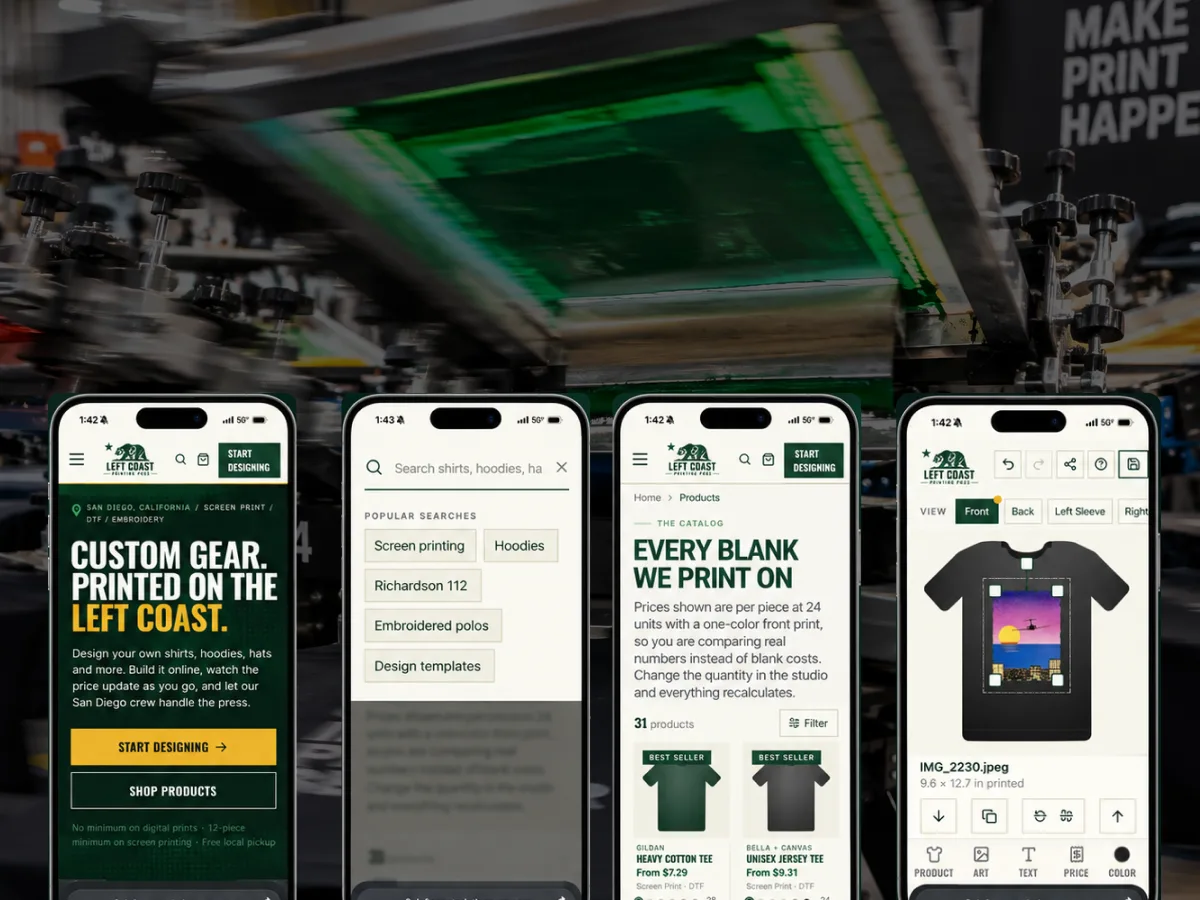
A print shop site where customers place their own artwork on the garment — and the order arrives ready to produce.

A leading online IT training and certification platform helping people build technology careers through certifications and guided learning pathways.
Tell us the problem. We'll tell you honestly whether software is the answer — and bring the strategy, design, engineering and AI to build it.