
No enforced window
Orders trickled in past cutoff, so makers couldn't plan production against a number they could trust.
Built by Artifact · Live
Case study · Drop commerceDropQ is an operating system for independent sellers running timed product drops — scheduled preorder windows, live on-site QR sales, pickup scheduling, inventory, orders and customer messaging. Built for food makers, collectors, artists and vintage sellers.
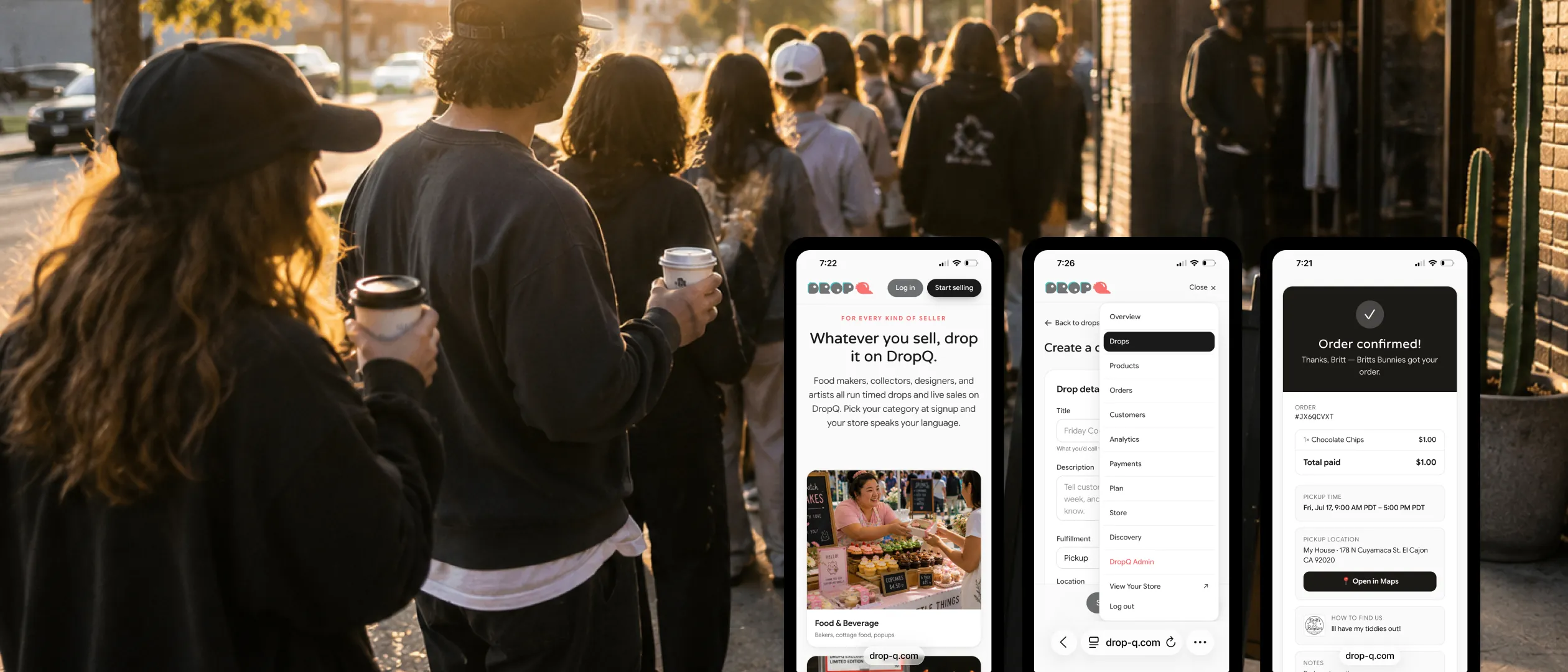
Vendor to buyer, end to end: create the drop, take the order, hand it over. Customer details blurred.
Orders trickled in past cutoff, so makers couldn't plan production against a number they could trust.
Overselling, or hand-tallying Instagram DMs at midnight. Neither is a system.
Customers arrived, couldn't find the vendor, and had no way to reach them. The drop succeeded and the handoff failed.
Fourteen days and 131 commits in, there was a live MVP: storefronts, drops, inventory, Stripe Connect payments. The first real drop took real money on 4 July, and instead of celebrating we audited the whole experience. The worst break wasn’t checkout. It was pickup — people standing in a parking lot, holding a paid order, unable to find the vendor.
That became the next build cycle: pickup windows, “how to find us” directions, open-in-Maps, opt-in vendor contact, vendor check-in, customer arrival — shipped within a week. Speed got us to a real transaction, and only a real transaction could tell us what was actually broken.
An atomic conditional SQL claim; lost races auto-cancel and refund. Not a validation rule — a guarantee.
Vendor-branded link previews, emails and storefronts. The platform stays out of the vendor's relationship with their customer.
Order links work as capability URLs with localStorage saves. Nobody signs up to buy a cookie.
UTC instants authored in each vendor's IANA zone — because a drop that opens an hour late is a drop that failed.
Data model, Stripe Connect payments, messaging, scheduling, auth and every screen — one team, whole stack, no handoff.