
I Design and Build With AI. I Don't Ship Slop.
AI democratized execution. It did not repeal best practices — and when everybody can build, what you build matters more.
I design with AI. I build with AI. I use AI in strategy, UX, visual design, prototyping, development, content, research, and increasingly throughout the entire product lifecycle.
I believe in this technology.
I also think we need to talk about the slop.
You know it when you see it.
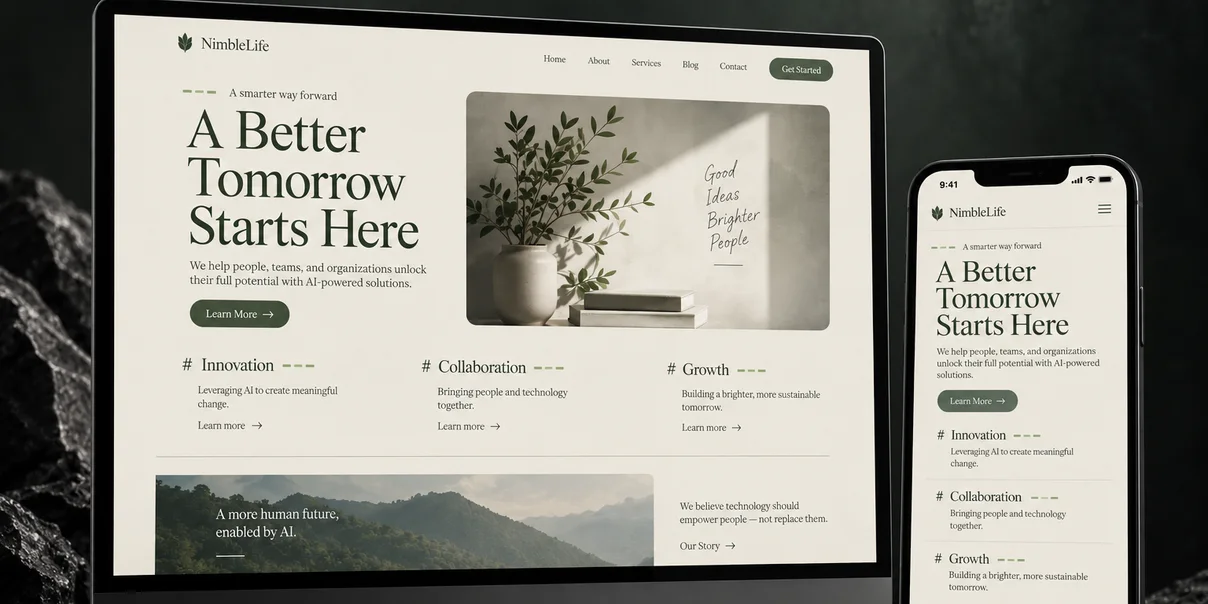
A beige screen. Maybe pale green if somebody was feeling adventurous. A giant sentence explaining what the product does, followed by a tiny eyebrow floating somewhere above it. There’s probably a dash before the eyebrow. Or a dot. Or both.
— INTELLIGENT WORKFLOWS FOR MODERN TEAMS
Why is the text 11 pixels tall?
Why is it letter-spaced like the opening credits of a science-fiction movie?
Why does every card have the same visual weight?
Why are there six things on the screen that look like buttons, but none of them make me want to click?
And why does every AI startup suddenly look like it belongs to the same beige-and-sage-green parent company?
That’s AI slop.
And the problem isn’t really beige.
The problem is that nothing has been designed.
The interface exists. It may even work. But there’s no hierarchy. No obvious next action. No tension. No rhythm. No moment of delight. No understanding of what deserves attention and what should disappear into the background.
Nothing says:
Start here. This is important. Click me. You did it. Here’s what happens next.
AI can generate an interface incredibly quickly.
That does not mean it designed a product.
The Most Dangerous Thing About AI Slop Is That It Works
This is what makes the current moment so interesting.
For most of my career, getting something onto a screen required enough effort that several disciplines naturally became involved. Someone thought about the business. Someone thought about the user. Someone figured out the architecture. Someone designed the interface. Someone thought through interactions. Someone built it. Someone tested it.
That process could be painfully slow. There were too many meetings, too many handoffs, and sometimes too many people.
AI has blown that model apart.
Today I can go from an idea in my head to working software at a speed that would have seemed ridiculous a few years ago. That’s extraordinary.
But we’ve also removed many of the gates that used to force an idea to encounter expertise before becoming software.
Now you can describe an application, open an IDE, start prompting, and have something running before lunch.
And because it runs, we confuse functional with good.
That is where the slop comes from.
AI is incredibly good at producing the statistical average of what software looks like.
The problem is that nobody falls in love with the statistical average.
I Go to AI Founder Meetups and Think, “These People Ain’t Found Shit.”
I mean this with love.
I go to AI founder events. I meet smart people. Ambitious people. Technical people. People genuinely trying to build something new.
And occasionally I have this thought: these people ain’t found shit.
They have founded a company. They have a domain. They have an AI wrapper. They have an animated gradient. They have 14 agents talking to each other.
But they haven’t necessarily found a product yet.
That’s not an insult. It’s actually an opportunity.
Because we’re living through a period where the ability to make software has suddenly become much more widely distributed than the ability to make good software.
Those are different skills.
A founder can now produce an MVP without understanding information architecture. A developer can generate an interface without understanding visual hierarchy. A designer can generate production code without understanding software architecture. A marketer can generate a landing page without understanding interaction design.
That’s amazing.
But removing the technical barrier doesn’t remove the need for the discipline.
AI democratized execution. It did not repeal best practices.
Taste Isn’t Enough Either
There’s another idea floating around right now that I don’t completely buy: in the age of AI, taste is everything.
Taste matters enormously. But taste alone isn’t enough.
You can know that something looks bad without understanding why it doesn’t work.
Good digital product design isn’t just the ability to pick a beautiful typeface or recognize a fashionable aesthetic. Before I ever needed to know how to flip open an IDE and work alongside an AI coding agent, I needed to understand what made a good product.
Can someone understand what this page is about in a few seconds? What is the primary action? What is secondary? What information can disappear until it’s needed? Can I scan the interface? Does the language match the user’s mental model?
Can I use it with a keyboard? Does it work on a phone? What happens when there’s no data? What happens when there’s too much data? What happens when something fails? Does the interaction provide feedback?
Does the visual system communicate the brand? Is there enough contrast? Is the type readable? Does motion help communicate state, or is it decoration? What happens after I click?
Those aren’t matters of taste.
Those are matters of craft.
AI Slop Has No Hierarchy
This may be the biggest tell.
Hierarchy is almost nonexistent in AI-generated interfaces unless somebody deliberately creates it.
Everything becomes a card. Every card gets an icon. Every icon gets a little colored circle. Every section gets an eyebrow. Every eyebrow gets excessive letter spacing. Every section gets roughly the same padding. Every headline is roughly the same size. Every button gets roughly the same importance.
Then we wonder why the interface feels dead.
A great interface is not democratic. It makes decisions. It tells you what matters most.
Sometimes the right design decision is a 64-pixel headline. Sometimes it’s one enormous button. Sometimes it’s removing six things from the screen. Sometimes it’s allowing an image to dominate. Sometimes it’s making one number enormous because that’s the only number the user really cares about.
Sometimes it’s saying: there is one thing I want you to do here, and I am not going to make you hunt for it.
AI doesn’t naturally make those decisions because those decisions require context, intent, judgment, and sometimes courage.
You have to direct it.
Stop Asking AI to Make Things “Look Better”
This is one of the biggest practical changes I’d recommend to anyone building with AI.
Don’t tell it: make this look better.
Give it principles.
Tell it what the user needs to accomplish. Define the hierarchy. Define the design system. Give it typography rules. Give it spacing rules. Give it interaction rules. Explain what the primary CTA is and why. Tell it what should happen at mobile breakpoints. Define hover, focus, loading, empty, success, and error states.
Give it references — but understand why those references work.
Tell it what not to do.
That last part is surprisingly important.
I routinely tell AI: don’t turn everything into cards. Don’t add gradients everywhere. Don’t use tiny uppercase eyebrows. Don’t center every section. Don’t make every CTA the same weight. Don’t add decorative icons that communicate nothing. Don’t replace real functionality with mock data to make the screen prettier. Don’t destroy usability in pursuit of minimalism. Don’t make it look like generic AI SaaS.
Suddenly the work gets better.
Not because the model magically developed taste. Because you’ve given it direction.
Start With Best Practices, Not Prompts
This is what I want more people entering AI product development to understand.
Don’t start by learning the perfect prompt. Start by learning what good looks like.
Study products that work. Learn basic UX heuristics. Learn typography. Learn hierarchy. Learn information architecture. Learn accessibility. Learn interaction design. Learn responsive behavior. Learn design systems.
Learn how people actually scan screens. Learn what makes a button feel clickable. Learn why a form feels exhausting. Learn why one onboarding experience feels effortless and another feels like doing your taxes. Learn why some software disappears beneath the task while other software constantly reminds you that you’re operating software.
Then bring AI into that knowledge.
That’s when things get interesting.
Because now AI isn’t replacing your expertise. It’s multiplying it.
There Is No Free Lunch
AI has made building dramatically faster. It has made some things dramatically cheaper. It has allowed small teams to attempt things that previously required much larger organizations.
All of that is real.
But there is no free lunch.
If your competitors have access to the same models, the same frameworks, the same component libraries, the same coding agents, and the same generation tools, simply using AI isn’t an advantage.
It’s table stakes.
The advantage is what you can do with it.
AI can give you 80 percent remarkably quickly.
Unfortunately, customers experience the other 20 percent.
They experience the confusing navigation. The tiny text. The broken mobile state. The meaningless dashboard. The button nobody notices. The generic onboarding. The loading state you forgot. The copy that sounds like AI wrote it. The interaction that technically works but feels terrible. The product that could belong to any company because nobody bothered to make it belong to yours.
That’s where the work is now.
AI Slop Will Not Sell
Maybe some of it will. For a while. Novelty can cover a lot of sins.
But as AI software becomes ubiquitous, expectations will rise quickly.
Soon, saying your product uses AI will be about as differentiated as saying your website uses JavaScript.
Customers won’t care.
They’ll care whether it helps them. They’ll care whether they understand it. They’ll care whether they trust it. They’ll care whether their employees actually use it. They’ll care whether it feels like their organization. They’ll care whether it saves time. They’ll care whether the experience is delightful enough that they want to come back.
That means the bar isn’t going down because AI makes software easier to produce.
The bar is going up.
When everybody can build, what you build matters more. When everybody can generate an interface, design matters more. When everybody can produce content, voice matters more. When everybody can ship, craft matters more.
This Is Why I’m More Excited About Design Than Ever
I’m not pessimistic about AI design. I’m the opposite.
I think this might be one of the most exciting moments to be a designer, builder, strategist, or product person.
For years, talented people spent enormous amounts of energy fighting the machinery required to turn ideas into reality. Now that distance is collapsing.
I can think strategically, design visually, prototype an interaction, build the experience, test it, change the architecture, and see another version incredibly quickly.
That doesn’t make design less valuable. It gives design more leverage.
The people who will create exceptional AI products won’t necessarily be the people who can generate the most code. They’ll be the people who can recognize a human problem, understand it deeply, imagine a better experience, establish a point of view, and then use AI to execute that vision at extraordinary speed.
That’s what we’re trying to do at Artifact Digital.
We use AI. A lot. We design with it. We build with it. We challenge ideas with it. We prototype with it. We accelerate development with it.
But the goal isn’t to produce more stuff. The goal is to produce better products.
Useful products. Usable products. Beautiful products. Products with hierarchy. Products with personality. Products that feel unmistakably connected to the brands behind them. Products where interaction has meaning. Products where somebody actually thought about the person on the other side of the screen.
So yes, open the IDE. Use the agent. Generate the prototype. Build something tonight that would have taken six months five years ago.
That’s incredible.
Just don’t confuse the fact that AI helped you ship something with the idea that the thing was worth shipping.
Learn the fundamentals. Develop your point of view. Study good products. Sweat the interactions. Respect the user. Break the template when the template isn’t serving them.
And for the love of design, we can probably give the beige and green a rest.
Build with AI.
Just don’t ship slop.