
No front door
Scripture, devotionals, study, events, media and photos lived in scattered places — or nowhere — for a community that is largely 70 and over.
Built by Artifact · Prototype
Case study · Mobile app & admin platformTwo working products for a senior-living ministry, deployed as a prototype: a Scripture-first daily formation app for residents, staff and the surrounding community — and a web admin portal that lets non-technical ministry staff run the content, events, messaging and people behind it.

The admin portal staff actually run. Figures shown are sample data — the product has no users yet.
Scripture, devotionals, study, events, media and photos lived in scattered places — or nowhere — for a community that is largely 70 and over.
Small type, low contrast, tiny targets and feature buffets fail this audience specifically. It shaped every decision we made.
Content, media, livestreams, events and resources were all code-level. Nothing moved without a developer.
The brief pointed at YouVersion — the natural reference, and exactly wrong. It’s dense, young and gamified where a pastoral ministry needs warm and unhurried, so we started from the ministry’s own identity instead and cut a home screen of eight tiles and six cards down to one action: “Continue Reading.” For an audience of 70+, the question isn’t what they can do. It’s whether they know what to do first.
Content runs through swappable providers on a mock data layer, with full SQL migrations and row-level security written and waiting — an honest prototype without a persistent spine. And the whole KJV is bundled rather than fetched from a Bible API, so it works in airplane mode.
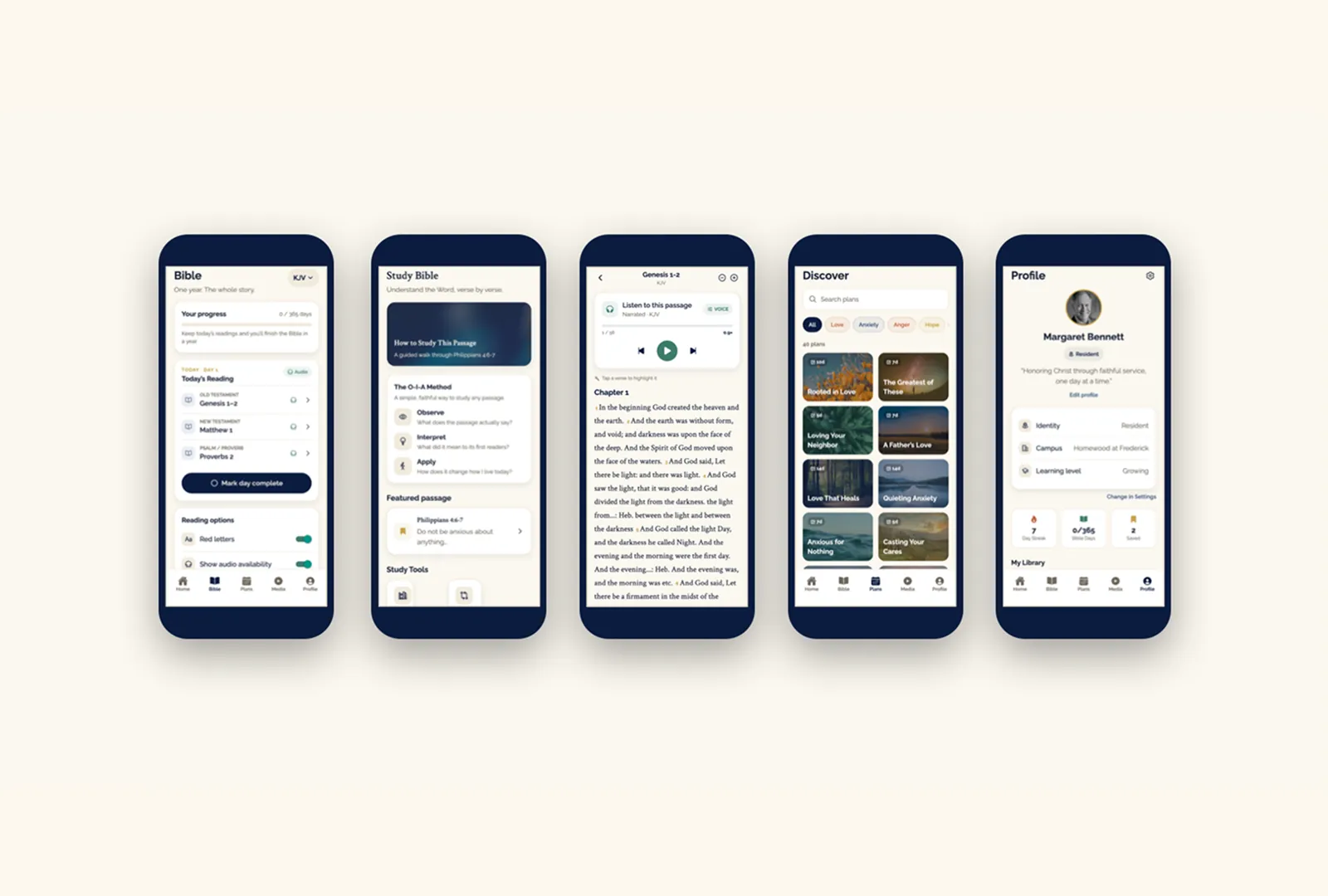
A full mobile app and an admin portal, both deployable and shareable by URL, with clean production builds and zero TypeScript errors.
The entire KJV bundled — no network, no rate limits, no licensing exposure. It works on a plane.
Verse-by-verse follow-along highlighting with voice and speed selection, working on iOS, Android and web.
11 sections, five roles with server-enforced access, audit logging, and a Media + Resources CMS with scheduling, bulk actions and import/export.