
The Most Important Signal a University Receives May Be the One It Sees Before Something Goes Wrong
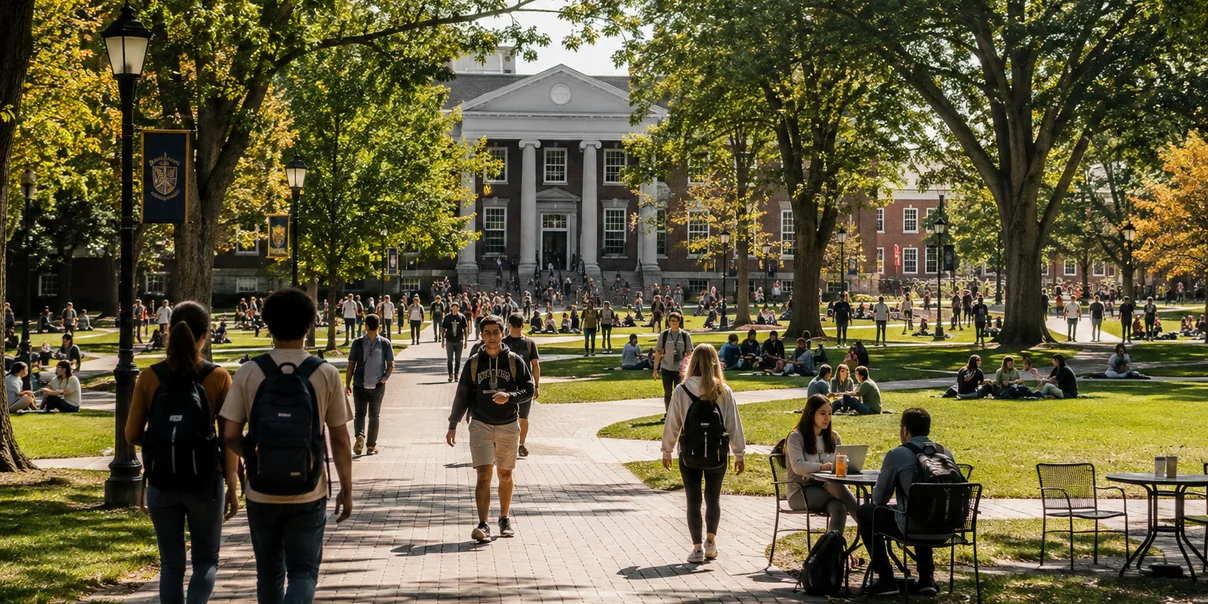
After decades of working with leaders and organizations, I’ve learned that transformation rarely begins with technology. It begins when the right people can finally see what is actually happening.
I’ve spent more than 35 years working with leaders, organizations, ministries, churches, businesses, and communities across the United States and around the world.
I’ve had the privilege of working with remarkable people.
I’ve watched organizations grow, merge, struggle, reinvent themselves, and occasionally fail. I’ve sat across the table from leaders facing decisions that would affect thousands of people. I’ve helped bring people together around opportunities that none of them could have accomplished alone.
And after all those years, I’ve become convinced of something fairly simple:
Most organizations don’t suffer from a lack of people who care. They suffer from not seeing what is happening soon enough.
By the time a problem becomes obvious, it has often been developing for months or even years.
By the time a relationship breaks, there were usually signals. By the time someone leaves, there were signals. By the time an organization realizes something isn’t working, there were signals.
And when I look at higher education today, I see an enormous opportunity hiding inside that reality.
Universities are surrounded by signals. Every student interaction, every course, every conversation, every assignment, every relationship, every success, and every struggle tells us something.
The question is whether we can recognize what those signals are telling us while there is still time to do something about them.
At Artifact Digital, this is something our team has been thinking about in different forms since 2019. Today, advances in artificial intelligence are giving us new ways to approach the problem. We’re exploring that future through something we call a Predictive Learning Platform, or PLP.
But I want to be clear about something from the beginning.
For me, this isn’t primarily a technology story. It’s a people story.
I’ve Spent My Career Connecting People
If I had to describe one consistent thread through my career, it would probably be connection.
I’ve spent decades connecting people around ideas, opportunities, organizations, and missions.
I’ve worked across all 50 states and 73 countries. I’ve worked with some of the largest ministries in America. I spent ten years at Life.Church as Pastor of Partnerships. I’ve participated in more than 70 church mergers and strategic transitions.
Those experiences have put me in a lot of interesting rooms. But more importantly, they’ve allowed me to see organizations from a lot of different perspectives.
I’ve sat with the person at the top carrying responsibility for the entire organization. I’ve talked with the people doing the work every day. I’ve watched organizations where communication flows beautifully and organizations where everyone cares deeply but operates in separate worlds.
I’ve seen what happens when the right people get connected around the right information.
And I’ve seen what happens when they don’t.
That experience shapes the way I look at what we’re building at Artifact. Because when I look at a university, I don’t see a collection of software systems.
I see people.
A University Is a Network of Relationships
Think about everyone who makes a university possible.
There are presidents and administrators. Faculty and professors. Teaching assistants and advisors. Students. Parents and families. Alumni. Staff. Donors. Community partners. Employers.
Each one experiences the institution differently.
A professor may know that a student has suddenly stopped participating. An advisor may know that the same student is struggling to keep up academically. Another part of the institution may see something else. A parent may know their son or daughter is questioning whether they belong there at all.
Each person may hold one piece of the story.
But who can see the whole story?
That’s the question that fascinates me.
Because a university is not really a collection of departments. It’s a living network of relationships.
And relationships generate signals.
We Usually Know Too Late
One of the lessons I’ve learned through organizational leadership is that there is an enormous difference between information and timely information.
If you tell me today that something went wrong six months ago, I can learn from it. If you tell me something appears to be going wrong right now, I might be able to change it.
That’s a very different kind of value.
Higher education has become extremely good at recording outcomes.
We know who enrolled. We know who completed an assignment. We know what grade someone received. We know who passed a course. We know who graduated. We know who didn’t return. Eventually, we know who left.
But I keep coming back to the same question: when did we first have enough information to know that something was changing?
A student doesn’t usually decide to leave a university in one moment. A struggling course doesn’t suddenly become a struggling course when final grades are entered. An alumnus doesn’t become disconnected from an institution five years after graduation because of a single email he didn’t open.
Relationships develop over time. So do problems. And so does success.
The earlier we understand the direction of those relationships, the more opportunity we have to strengthen them.
What If Someone Had Known?
Over the years, I’ve had countless conversations with people about moments that changed the direction of their lives.
Sometimes those moments were enormous. But often they were surprisingly small.
Someone noticed. Someone called. Someone asked a question. Someone made an introduction. Someone encouraged them. Someone stepped in at exactly the right time.
Those moments matter because timing matters.
Think about a student who begins struggling in a class. Maybe she doesn’t understand something during week three. She doesn’t say anything. By week four, she’s falling behind. Then she does poorly on an assignment. Her confidence drops. She participates less. Another assignment comes. Then another.
Eventually, everyone can see there’s a problem.
But what if someone had recognized the change three weeks earlier?
What if the professor had known? What if the TA had known? What if an advisor had known? What if the student herself had been given a clearer picture of where she stood?
Maybe nothing changes. But maybe everything does.
That’s why I believe predictive technology in education needs to be understood differently.
The purpose isn’t to predict someone’s failure. The purpose is to create another opportunity for someone to succeed.
Technology Should Help People Show Up for People
I understand why people can become nervous when we start talking about artificial intelligence, data, and prediction. We should be thoughtful about it.
Students aren’t numbers. They’re not probabilities. They’re certainly not outcomes waiting for an algorithm to determine.
They’re people.
And no technology should replace the judgment, compassion, experience, or relationship of a good professor, advisor, mentor, or leader.
I believe the goal should be exactly the opposite. Technology should help those people know when their humanity is needed most.
That’s a very different vision of AI.
Imagine technology quietly recognizing that something has changed and helping bring that change to the attention of someone who can help.
Then the human takes over. The professor teaches. The advisor calls. The mentor listens. The administrator removes an obstacle. The student gets another chance.
To me, that’s where technology becomes meaningful.
The University as a Living Loom
One of the metaphors behind our thinking at Artifact is a loom. I like it because it describes something I’ve seen throughout my career: organizations are made from relationships.
Picture every person connected to a university as a thread.
A student is a thread. A professor is a thread. A TA is a thread. An administrator is a thread. A parent is a thread. An alumnus is a thread.
Then add every class, program, resource, conversation, interaction, success, and struggle.
Thousands of threads are constantly crossing one another. No individual thread tells the story. But together they create the fabric of the institution.
Today, universities have tremendous technology for managing individual parts of that fabric. What interests us is the possibility of understanding the pattern being created across it.
That’s where the idea of a Predictive Learning Platform becomes interesting.
Not another system that asks everyone to do more. Not another dashboard. Not another place for a professor to log in. But a way of helping the institution learn from the relationships and experiences already happening across it.
Universities Already Have Enormous Amounts of Information
Something else I’ve learned in conversations with organizations is that the first instinct is often to assume we need more data.
Sometimes we do. But often the organization is already sitting on an extraordinary amount of information.
Universities certainly are. Learning management systems. Student information systems. Admissions systems. Advising tools. Course information. Communications. Surveys. Student services. Alumni and advancement systems. The list continues.
The problem isn’t necessarily collecting another mountain of data. The opportunity is making existing signals more meaningful.
At Artifact, we’re being very intentional about how we approach that challenge. There are aspects of our Predictive Learning Platform that we’re not discussing publicly yet. That’s deliberate. We’re continuing to research, build, test ideas, and most importantly, listen to the people who understand these institutions firsthand.
But our vision is straightforward: what if a university could continuously learn from itself?
See. Learn. Respond. Adapt.
Imagine an institution operating within an active feedback loop.
It sees what is happening. It learns from what it sees. People respond. Then the institution learns from the response.
See. Learn. Respond. Adapt. And continue.
That seems simple. In reality, it represents a profound change in how institutions can operate.
Most institutional reporting looks backward. What was our retention rate? How did students perform last semester? What did our annual survey tell us? How many students graduated?
All of those questions matter.
But imagine adding another set of questions. What appears to be changing? Where are students thriving right now? Where are they beginning to struggle? Are multiple students encountering the same problem? Which interventions appear to be helping? Where are relationships strengthening? Where are they weakening?
What should a human being pay attention to today?
That last question may ultimately be one of the most important.
This Is Bigger Than Retention
I spend a lot of time talking with leaders about growth. But sustainable growth rarely comes from simply acquiring more people. It comes from creating stronger relationships with the people already connected to your organization.
That’s why I think the opportunity here goes far beyond student retention.
Consider the complete relationship someone can have with a university.
A prospective student discovers the institution. They apply. They enroll. They become a student. They build relationships with professors and other students. Their family develops a relationship with the institution. Eventually, they graduate.
Now they’re an alumnus. They might remain connected for another 50 years. They may hire graduates. They may mentor students. They may give financially. They may advocate for the institution. Their children may eventually attend.
We tend to divide those experiences organizationally. Admissions. Student experience. Academics. Advancement. Alumni relations.
But to the person experiencing them, they’re chapters of one story.
That’s an important distinction. If universities can better understand the entire relationship, they have an opportunity not only to improve student outcomes but to strengthen the institution itself.
Why Artifact Has Been Thinking About This Since 2019
It’s important to say that Artifact didn’t wake up when ChatGPT became popular and decide that higher education needed some AI.
Our team has been thinking about the intersection of people, digital experiences, behavior, learning, data, and technology since 2019.
Artificial intelligence has accelerated what’s possible. But the questions that drive us are fundamentally human questions.
Where are people struggling? Why? What signals are we missing? Where is information trapped? What do people need at the moment they need it? What makes an experience successful? What strengthens a relationship? What causes someone to disengage? How can we know earlier?
Those are experience questions before they’re technology questions.
And I think that matters. Because AI without a deep understanding of people is just technology looking for a problem.
We’re approaching this from the other direction. We’re starting with people.
My Job Is to Keep Bringing the Right People Into the Conversation
I’m not the person at Artifact writing the models or architecting the technology behind our Predictive Learning Platform. That’s not my role.
My role is something I’ve been doing for most of my life: bringing the right people around the right idea at the right time.
I want to talk with university presidents. Provosts. Professors. Technology leaders. Student success teams. Researchers. Parents. Students.
People who have spent their careers inside higher education. People who love their institutions enough to tell us where they’re broken. People who will challenge our assumptions. People who understand privacy and governance. People who understand learning science. People who understand what professors actually need. People who understand what students actually experience.
Because I don’t believe something this important should be built in isolation.
Technology companies have a bad habit of building what they think organizations need and then showing up with a sales presentation. I don’t think that’s how meaningful transformation happens.
You listen first. You build relationships. You bring the right people together. You understand the mission. Then you determine where technology can help.
I Believe the Best Institutions of the Future Will Be Learning Institutions
After decades of working around organizational transformation, I’ve noticed something about organizations that endure.
They’re willing to learn. Not once every five years during a strategic planning process. Continuously.
They listen. They recognize changes. They respond. They adapt without losing who they are.
I believe universities will increasingly need that capability.
The world around higher education is changing quickly. Student expectations are changing. Technology is changing. The economics of education are changing. The workplace students are preparing to enter is changing. Artificial intelligence is changing almost everything.
Institutions cannot control all of those forces. But they can become better at learning from what’s happening inside their own communities.
That’s what excites me about the idea of a Predictive Learning Platform.
Not prediction for prediction’s sake. Not AI because AI is fashionable. Not another technology platform promising to solve everything.
A living feedback loop that helps people understand people. An institution capable of seeing patterns earlier. Professors equipped to respond sooner. Students given more opportunities to succeed. Families connected more meaningfully. Alumni relationships that don’t begin after graduation but grow naturally from the student experience.
And leaders with a clearer picture of what’s actually happening across the institution they have been entrusted to lead.
After 35 years of working with leaders and organizations, I’ve learned that there are moments when the right connection can change everything. The right person. The right information. The right conversation. At the right time.
Higher education already has extraordinary people. It already has enormous amounts of information. And every day, its students, faculty, families, administrators, and alumni are generating signals about what’s working and what isn’t.
Maybe one of the biggest opportunities ahead isn’t collecting more information.
Maybe it’s learning to hear what those people are already telling us — before it’s too late to do something about it.