
Find the real job
We identify where AI or interactivity genuinely improves the experience — and rule out where it would only add risk or noise.
AI-powered features, generative interfaces, and motion-led experiences that make a product feel modern and alive. The interesting question isn't whether to add AI — it's where it genuinely makes the experience better.
I've been building with these tools since late 2020, back when the outputs were rough and the hype was already deafening. Here's the short version of what I've learned: AI is otherworldly at generating options and speeding up thinking, and genuinely bad at owning an outcome or being accountable when it's wrong. The interesting design work lives right on that line.
Most 'AI features' shipping right now are a text box bolted onto a product with a sparkle icon next to it. Sometimes that's right. Usually it isn't. The better move is to ask what job the user is really doing, then decide where AI removes friction and where it adds new friction — hallucinated answers, unpredictable behavior, a lost sense of control.
The same goes for motion and interactivity. Used well, they make a product feel considered and alive; used carelessly, they're noise that gets in the way. We treat both AI and motion as means to an end — a clearer, more trustworthy, more memorable experience — never as decoration.
Traditional software is deterministic. AI isn't — it's probabilistic and occasionally confidently wrong, and that changes the design problem. The interface has to assume the model will sometimes be mistaken and make that failure graceful instead of dangerous.
So we design the unhappy path first: how the user notices an error, how they correct it, how much to trust a given output, and what the safe fallback is. An AI feature that only works when the model is right isn't finished. Handling the wrong answer well is what separates a real product from a demo.
Interactive and motion-led experiences are part of what makes a product feel modern, but motion should always earn its place. We use it to guide attention, explain change, and give the interface personality — not to show off.
Done right, a considered transition or a well-timed interaction makes a product feel alive and trustworthy at the same time. Done wrong, it's friction dressed up as delight. We know the difference, and we design for the first one.
We identify where AI or interactivity genuinely improves the experience — and rule out where it would only add risk or noise.
AI and motion have to be felt to be judged, so we build rough, working prototypes early rather than trusting static mockups.
We design the wrong-answer path — error, correction, trust cues, safe fallbacks — so the experience holds up in production.
We instrument the experience, watch how people actually use it, and refine where trust and usefulness diverge.
 View case →
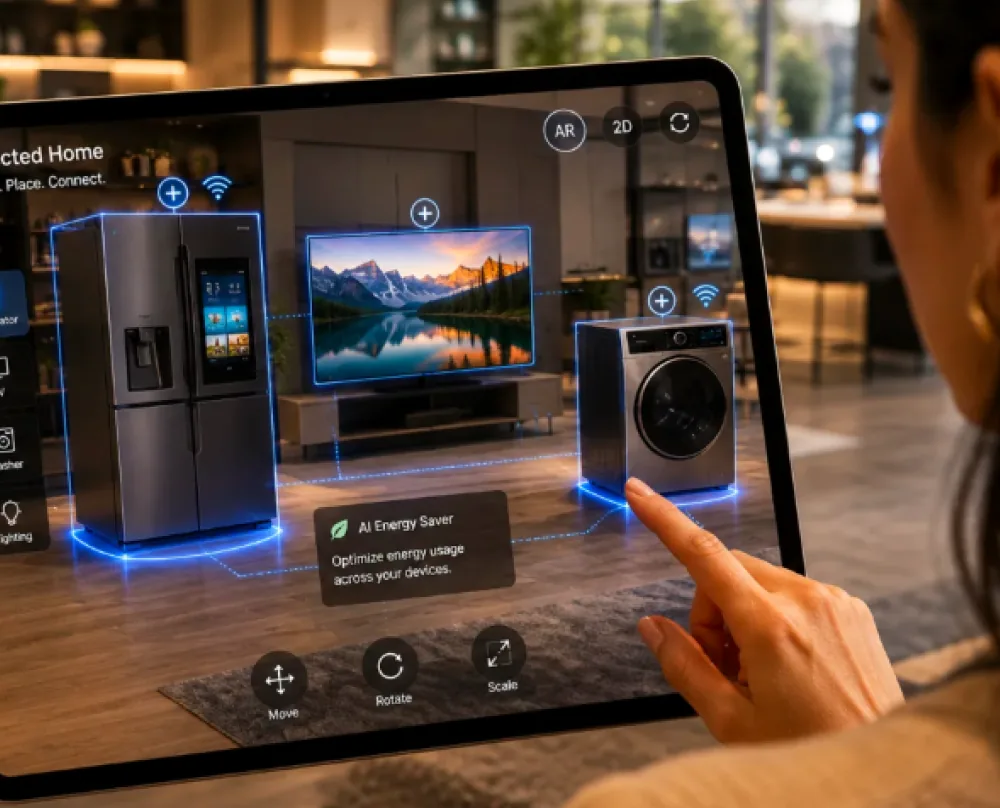
 An in-store AR experience showcasing the company's Connected Home products.
 View case →
 A leading online IT training and certification platform helping people build technology careers through certifications and guided learning pathways.
 View case →
 An AI website improvement platform that audits your site against real competitors and turns the findings into prioritized, trackable work.
Tell us where you want to go. We’ll bring the strategy, design, AI and engineering to get you there.